
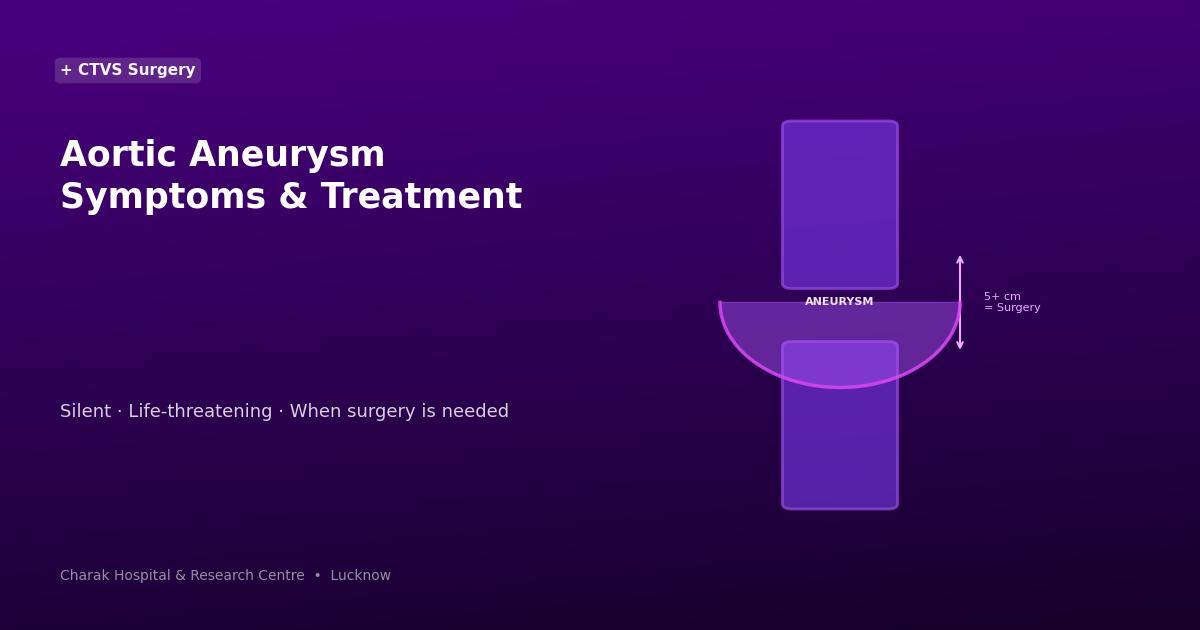
The aorta is the body's largest artery — a vessel the width of a garden hose that carries blood from the heart to the rest of the body. An aortic aneurysm is an abnormal bulge or ballooning in the wall of the aorta. Like a weak spot on a tyre, it silently grows over years — and if it ruptures, survival is very unlikely without immediate emergency surgery. The key to surviving an aortic aneurysm is finding it before it ruptures.
Sudden severe tearing or ripping pain in the chest, back or abdomen — especially with collapse or extreme weakness — could be aortic dissection or rupture. Call 05226664444 emergency immediately. Every minute matters.
In This Article
1. Types of Aortic Aneurysm
- Thoracic Aortic Aneurysm (TAA) — affects the aorta inside the chest. The most dangerous location is the ascending aorta (nearest the heart), which is associated with aortic valve disease and genetic conditions like Marfan syndrome.
- Abdominal Aortic Aneurysm (AAA) — more common; affects the aorta in the abdomen, usually below the kidneys. Most common in men over 65 who smoke.
- Thoracoabdominal Aneurysm — extends from the chest into the abdomen; the most complex type to repair.
2. Symptoms — Why It's Called Silent
Most aortic aneurysms cause no symptoms at all until they are very large or until they rupture or dissect. This is why they are so dangerous. When symptoms do occur, they may include:
Deep back or flank pain (AAA)
Chest or jaw pain (thoracic)
Breathlessness or hoarse voice
Pulsating feeling in abdomen
Dizziness or collapse
Sudden tearing pain = emergency
Many abdominal aneurysms are discovered incidentally — on an ultrasound or CT scan done for another reason. Never dismiss a pulsating lump felt in the abdomen.
3. Causes and Risk Factors
- Atherosclerosis — the same plaque build-up that causes heart attacks weakens artery walls
- Hypertension — constant high pressure stresses and stretches the aortic wall
- Smoking — one of the strongest independent risk factors for AAA; smokers are 7× more likely to develop AAA
- Age and gender — men over 65 are at highest risk for AAA
- Family history — having a first-degree relative with an aortic aneurysm significantly increases your risk
- Connective tissue disorders — Marfan syndrome, Loeys-Dietz syndrome, Ehlers-Danlos syndrome cause thoracic aneurysms in younger people
- Bicuspid aortic valve — associated with ascending aortic aneurysm
- Infection or inflammation — rare; syphilis, giant cell arteritis
4. How Is It Detected?
- Ultrasound abdomen — the screening test of choice for AAA; non-invasive, inexpensive, no radiation
- CT angiography (CTA) — the gold standard for planning; gives precise size, extent, and anatomy
- MRI — used for thoracic aneurysms and when radiation exposure must be minimised
- Echocardiography — assesses the ascending aorta and aortic root when aortic valve disease is present
Once an aneurysm is found, it is followed with imaging every 6–12 months to watch the growth rate. Growth of more than 5mm in 6 months is a warning sign.
5. When Is Surgery Needed?
The decision to operate balances the risk of rupture (which rises sharply with size) against the risk of surgery:
| Type | Surgery Threshold (diameter) |
|---|---|
| Ascending aortic aneurysm | ≥ 5.5 cm (or 5.0 cm with Marfan / bicuspid valve) |
| Descending thoracic aneurysm | ≥ 6.0 cm |
| Abdominal aortic aneurysm (AAA) | ≥ 5.5 cm in men, ≥ 5.0 cm in women |
| Any type — rapid growth | Growth > 5 mm in 6 months — surgery regardless of size |
| Any type — symptoms | Symptomatic aneurysm = urgent surgery |
6. Treatment Options
Open Surgical Repair
The aneurysm is opened and a synthetic graft (Dacron tube) is sewn in to replace the diseased aortic segment. This is the traditional, durable approach — the graft lasts a lifetime. It requires a major operation under general anaesthesia. For ascending aortic aneurysms, the heart-lung machine is used. The CTVS team at Charak Hospital's Vascular Surgery unit performs these complex repairs.
Endovascular Repair (EVAR / TEVAR)
A less invasive option for abdominal and some thoracic aneurysms. A folded stent-graft is delivered through the femoral artery in the groin and deployed inside the aneurysm under X-ray guidance — no chest or abdominal incision needed. Recovery is much faster (2–3 days hospital stay). However, not all aneurysm shapes are suitable for endovascular repair, and long-term follow-up CT scans are required.
Medical Management (for small aneurysms)
- Control blood pressure strictly — target BP below 130/80 mmHg
- Stop smoking — the single most important modifiable factor
- Statin therapy — reduces aortic inflammation
- Regular imaging surveillance every 6–12 months
- Avoid strenuous lifting and extreme exertion
7. Aortic Dissection — A Related Emergency
Aortic dissection is different from (but related to) aneurysm. In dissection, the inner layer of the aortic wall tears, and blood forces its way between the layers — potentially blocking blood flow to vital organs within minutes. It presents with sudden, severe, tearing chest or back pain — often described as the worst pain ever felt. This is a life-threatening emergency requiring immediate surgery. If you or someone near you has these symptoms, call emergency without delay.
8. Who Should Be Screened?
Discuss aortic aneurysm screening with your doctor if you:
- Are a man aged 65 or older — especially if you have smoked at any time
- Have a first-degree relative (parent, sibling) with an aortic aneurysm
- Have been diagnosed with a bicuspid aortic valve or Marfan syndrome
- Have been a long-term smoker with high blood pressure
A single ultrasound of the abdomen or an echocardiography can detect most aneurysms. Early detection means planned, elective surgery — far safer than emergency repair after rupture.
Concerned About an Aortic Aneurysm?
Our CTVS and vascular surgery team at Charak Hospital Lucknow offers screening, surveillance imaging, and surgical treatment for aortic aneurysms — including complex thoracic and thoracoabdominal repairs.
Book Consultation 05226664444
Dr. Vijay Agarwal
MBBS, MS, M.Ch – Cardiothoracic & Vascular Surgery
CTVS Surgeon, Charak Hospital Lucknow
View Profile →