
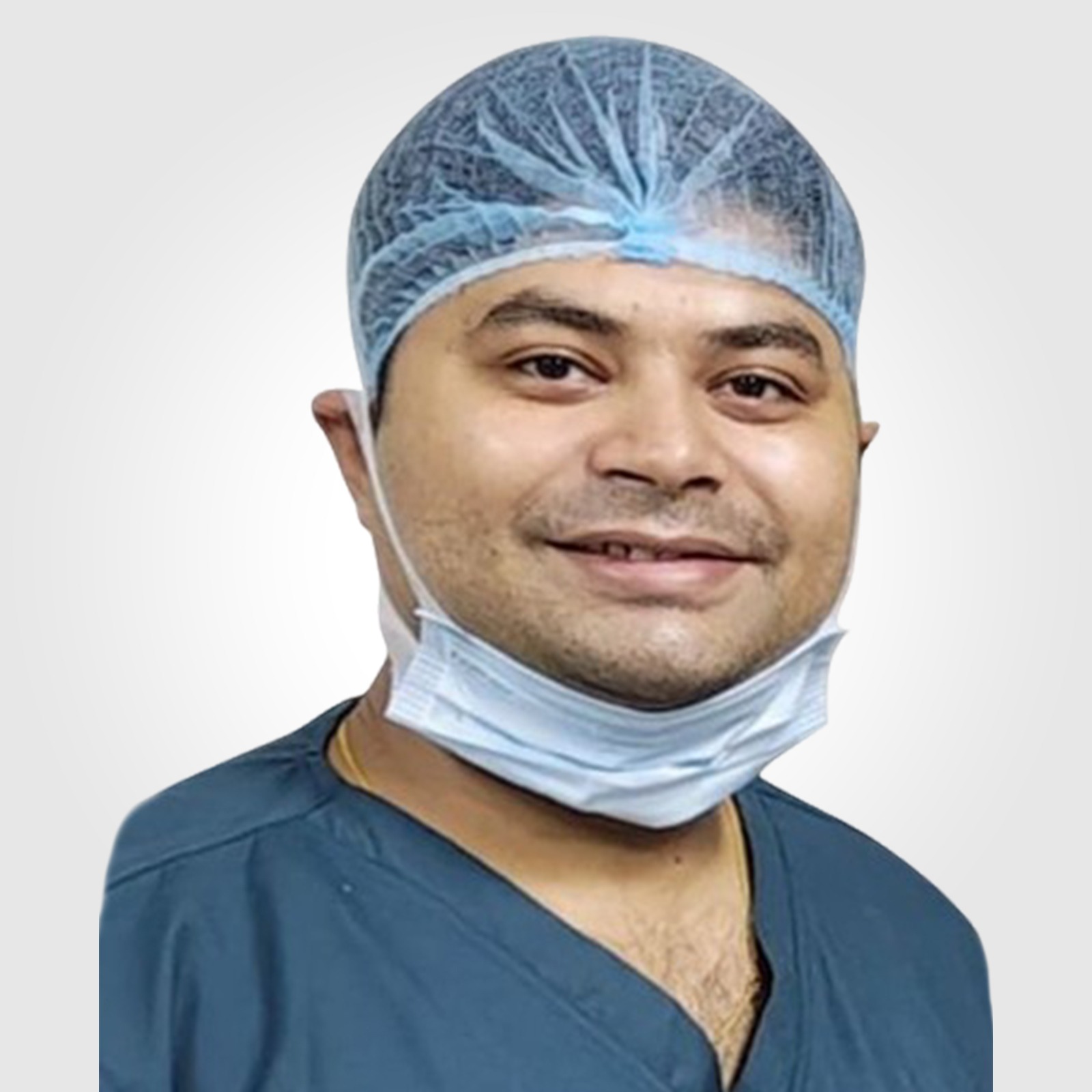
General & Laparoscopic Surgeon
Dr. Praveen Sharma
MBBS, DNB (General Surgery)
Laparoscopic and bariatric surgery, hernia, gallbladder and appendix surgery.

A hernia happens when part of an organ or fatty tissue pushes through a weak spot in the muscle wall, usually in the groin or abdomen. It often shows as a bulge that grows on standing or coughing and goes back on lying down. Hernias do not heal on their own, and many are repaired with surgery to prevent complications.
Share your details — our coordinator will call you back to schedule a visit.
Common types are inguinal (groin) hernia, more common in men; umbilical hernia near the navel; incisional hernia through an old surgical scar; femoral hernia, more common in women; and hiatus hernia, where part of the stomach slides up into the chest. Heavy lifting, chronic cough, constipation, pregnancy and obesity increase pressure on the abdominal wall.
Most are diagnosed on examination.
Ultrasound if unclear.
Open or keyhole surgery.
Back to routine in weeks.
Some hernias cause no symptoms apart from a bulge.
In the groin, navel or near a scar.
Bigger on coughing, standing or lifting.
A dragging feeling in the groin.
Ache when bending or lifting.
A groin hernia can extend into the scrotum.
Common in babies and after pregnancy.
In hiatus hernia.
Straining can make it worse.
Go to emergency if: the bulge becomes hard, painful or red, or cannot be pushed back, especially with vomiting or being unable to pass gas — the hernia may be trapped (strangulated). Call 0522-666-4444.
Most hernias are found on examination.
Standing and coughing to see the bulge.
When the diagnosis is unclear.
For complex or incisional hernias.
Blood tests and ECG before surgery.
Open or laparoscopic, based on type and health.
Surgery is the only way to repair a hernia.
The hernia is repaired from the inside through small cuts using a camera, and a mesh is placed to strengthen the wall. It is often used for hernias on both sides and recurrent hernias.
Small cutsGeneral anaesthesiaOften home the same or next dayA cut is made over the hernia, the tissue is pushed back and the wall is repaired, usually with mesh. It can be done under spinal or local anaesthesia in suitable people.
Spinal, local or general anaesthesiaMesh repairShort hospital stayGeneral guidance — always follow the advice your own doctor gives you.
Avoid heavy lifting for about 4 to 6 weeks after surgery, or as advised.
Eat fibre, drink water, and get constipation or a long-lasting cough treated.
Walk from the first day; most people return to office work in 1 to 2 weeks.
Tap a card to see the fact.
A belt may support the bulge but does not repair the weak spot.
Exercise does not close a hernia, and some exercises can worsen it.
Your surgeon may advise repair to stop the hernia from getting trapped.
MBBS, DNB (General Surgery)
Laparoscopic and bariatric surgery, hernia, gallbladder and appendix surgery.
MS, FMAS, M.Ch (Paediatric Surgery), BHU
Hernia, hydrocele, undescended testis and other children’s surgery. OPD: Monday to Saturday, 10 am – 5 pm.
A little preparation helps us help you faster.
Tick off as you pack:
Costs depend on the tests and treatment you need and the length of any hospital stay. Ask our team for a written estimate.
*Coverage depends on your policy and the treatment. Our insurance desk can check this for you.
Call 0522-666-4444A hernia does not close on its own. Some small hernias with few symptoms can be watched, but most are repaired.
Mesh is widely used and lowers the chance of the hernia coming back. Your surgeon will discuss the risks.
Light activity within days; heavy lifting after about 4 to 6 weeks.
Yes, occasionally. Avoiding straining and following advice lowers the risk.
No matching term. Please ask your doctor at your next visit.
Get it checked. See a surgeon at Charak Hospital or call 0522-666-4444.
Medical information disclaimer: This page provides general health information for patients and families. It is not a substitute for a consultation, diagnosis or treatment by a qualified doctor. Treatment decisions depend on each patient's individual condition. In an emergency, call 0522-666-4444 or go to the nearest emergency department.
About this page: Prepared by the Charak Hospital web team with the help of AI writing tools, using information from the Department of Minimal Access/Laparoscopic & Bariatric Surgery, Charak Hospital & Research Centre · Last updated: October 2026