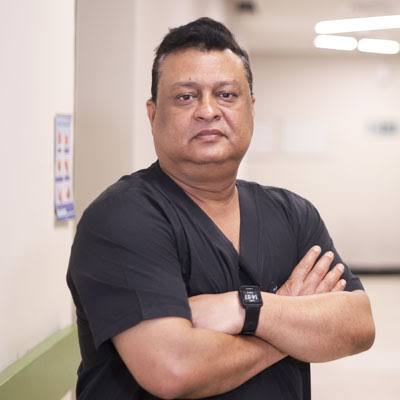
CTVS Surgeon
Dr. Vijay Agarwal
MBBS, MS, M.Ch (CTVS)
Bypass surgery (CABG), heart valve surgery and chest surgery.

The aortic valve controls blood flow from the heart to the rest of the body. When it becomes narrow (stenosis) or leaky (regurgitation), the heart has to work harder. At Charak Hospital, Hardoi Road, Dubagga, the cardiac surgeon and cardiologists assess the valve and plan repair or replacement when it is needed.
Share your details — our coordinator will call you back to schedule a visit.
In aortic valve replacement (AVR), the surgeon removes the damaged valve and stitches a new valve in its place, through an opening in the breastbone, with the heart-lung machine supporting the circulation. Some leaky valves can be repaired instead of replaced.
A narrowed valve that does not open fully.
A leaky valve that lets blood flow back.
Durable; needs lifelong blood thinners.
Usually short-term blood thinners; may wear out over time.
Many people have no symptoms at first. See a cardiologist if you notice:
On walking or climbing stairs, or lying flat.
Especially on exertion.
Particularly during activity.
Less able to do usual activities.
Heard by a doctor during a check-up.
Seen on echo, even without symptoms.
Fainting, chest pain or sudden breathlessness with a known valve problem needs urgent care. Call 0522-666-4444. Call 0522-666-4444.
Tap a card to read more.
Often younger patients.
Lifelong warfarin with INR tests.
Designed to last many years.
Often older patients or those who cannot take warfarin.
Usually for a few months only.
May need replacing after some years.
Some leaky valves.
Avoids long-term blood thinners in suitable cases.
Made by the surgeon based on the valve’s structure.
If coronary arteries are also blocked.
Similar to valve surgery alone, sometimes longer.
See our bypass surgery guide.
Bypass surgeryA new valve placed through a tube, usually from the groin.
Selected patients, often older or at high surgical risk.
Your heart team can discuss whether it is an option for you.
Regular echo checks and medicines for symptoms.
Medicines do not fix a narrowed valve.
Surgery is timed before the heart weakens.
No match found. Please call us on 0522-666-4444 — we will guide you.
These help confirm the diagnosis and plan surgery.
Shows how narrow or leaky the valve is.
Heart rhythm and lungs.
Checks the heart arteries, usually above 40 years of age.
Kidney, liver, sugar and clotting.
Treating dental infection before surgery.
Tap to compare.
Here is what to expect.
Under general anaesthesia, the breastbone is opened, the heart-lung machine is connected and the valve is repaired or replaced. Surgery usually takes 3 to 5 hours.
General anaesthesiaHeart-lung machineDrains and monitoring linesMost patients spend 1 to 3 days in the cardiac ICU.
Breathing tube removed within hoursBreathing exercises and sitting up earlyBlood thinners started when safeMost people go home about 6 to 8 days after surgery.
Walking and stairs practiceINR checks if on warfarinMedicines explainedSymptoms and echo reviewed.
Echo, angiography and blood tests.
Valve type, risks and costs explained.
Usually 3 to 5 hours.
About a week in hospital.
Echo, INR tests and rehab.
General guidance — always follow the instructions your surgeon gives you.
With a mechanical valve you will take warfarin or a similar medicine for life, with regular INR blood tests.
Keep your INR in the range your doctor sets. Tell every doctor and dentist that you have a valve.
Walk every day, increasing slowly. Avoid heavy lifting, pushing or pulling for 6–8 weeks while the breastbone heals.
Driving is usually avoided for about 4–6 weeks.
Look after your teeth and see a dentist regularly. Tell the dentist about your valve before any procedure.
Report fevers that do not settle — valve infections need early treatment.
Women with a heart valve should plan pregnancy with their cardiologist and obstetrician, as some blood thinners need changing.
Tap a card to see the fact.
Some severe valve problems damage the heart before symptoms appear. Regular echo checks help time surgery correctly.
Most people return to work and daily life. The main change is taking blood thinners and having INR tests.
Usually only for a few months, but other conditions such as an irregular heartbeat may still need them.
A soft clicking sound is normal with many mechanical valves.
MBBS, MS, M.Ch (CTVS)
Bypass surgery (CABG), heart valve surgery and chest surgery.

MBBS, MD (General Medicine), DM (Cardiology)
Angiography, angioplasty and stents, heart attack and heart failure care.

MBBS, MD (General Medicine), DM (Cardiology)
Coronary angiography and angioplasty, chest pain, high BP and heart rhythm problems.
A little preparation helps us plan your treatment.
Tick off as you pack:
The cost depends on the type of valve, whether other procedures are combined, and the length of ICU and hospital stay. Ask for a written estimate after your consultation.
*Coverage depends on your policy and the treatment. Our insurance desk can check this for you.
Call 0522-666-4444Usually 3 to 5 hours.
Most patients stay about 6 to 8 days, including 1 to 3 days in the ICU.
It depends on your age, other health conditions, lifestyle and whether you can take long-term blood thinners. Your surgeon will discuss this with you.
Risks include bleeding, infection, irregular heartbeat, stroke and kidney problems. Your surgeon will explain your own risk.
Mechanical valves are designed to last many years. Tissue valves may need replacing after some years.
TAVI suits selected patients. Your heart team can discuss whether it is an option for you.
Most health insurance policies and Ayushman Bharat PM-JAY cover valve surgery for eligible patients.
Call 0522-666-4444 or use the form on this page.
No matching term. Please ask your doctor at your next visit.
Bring your echo reports for a consultation. Call 0522-666-4444.
Medical information disclaimer: This page provides general health information for patients and families. It is not a substitute for a consultation, diagnosis or treatment by a qualified doctor. Treatment decisions depend on each patient's individual condition. In an emergency, call 0522-666-4444 or go to the nearest emergency department.
About this page: Prepared by the Charak Hospital web team with the help of AI writing tools, using information from the Institute of Cardiac Sciences, Charak Hospital & Research Centre · Last updated: October 2026
Videos
Short talks by Charak Hospital doctors on symptoms, prevention and treatment. General information only — not a substitute for a consultation.


