
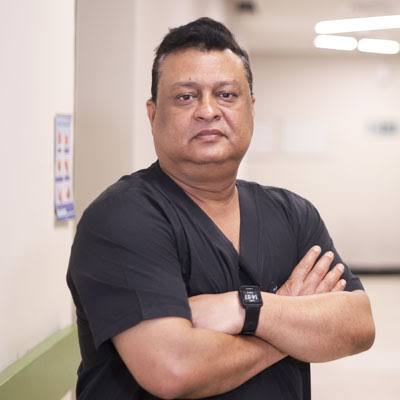
Interventional Cardiologist
Dr. Manish Kumar Jha
MBBS, MD (General Medicine), DM (Cardiology)
Angiography, angioplasty and stents, heart attack and heart failure care.

Angioplasty opens a narrowed or blocked heart artery from the inside, using a tiny balloon and usually a stent, through a small tube in the wrist or groin. At Charak Hospital, Hardoi Road, Dubagga, DM cardiologists perform angiography and angioplasty in the cath lab, including emergency angioplasty for heart attacks.
Share your details — our coordinator will call you back to schedule a visit.
In coronary angioplasty (also called PTCA or PCI), the cardiologist passes a thin tube (catheter) from an artery in the wrist or groin to the heart. A small balloon is inflated at the narrowing to open it, and a stent — a tiny mesh tube — is usually placed to keep the artery open. You are awake but sedated, and there is no large cut.
An X-ray dye test shows where the arteries are narrowed.
The narrowing is opened and supported.
Walking the same or next day for most planned cases.
Blood thinners keep the stent open.
Your cardiologist will advise angioplasty, bypass surgery or medicines based on your angiogram and symptoms.
Emergency angioplasty to open the blocked artery quickly.
Angina not controlled by medicines.
Due to reduced blood supply to the heart.
Showing a significant blockage.
Suitable for treatment with a stent.
Treated with a balloon or another stent.
Chest pain lasting more than a few minutes, especially with sweating or breathlessness, may be a heart attack. Call 0522-666-4444 or come to the emergency department at once — early treatment saves heart muscle. Call 0522-666-4444.
Tap a card to read more.
Dye is injected into the heart arteries and X-ray pictures are taken.
About 20–40 minutes.
Often home the same day.
As soon as possible after a heart attack starts.
Opening the artery quickly limits heart damage.
0522-666-4444, at any hour.
After angiography confirms a suitable narrowing.
A drug-eluting stent is used for most patients.
Usually 1–2 days.
Long, branching or calcified narrowings.
Special balloons, imaging and plaque-modifying devices when needed.
Bypass surgery may be advised for some patients.
Bypass surgeryNo match found. Please call us on 0522-666-4444 — we will guide you.
For planned angioplasty, these are usually done first.
Heart rhythm and pumping.
Kidney function, sugar, blood count and clotting.
For some patients, to show reduced blood flow.
Confirms the location and severity of blockages.
Options, risks and costs explained.
Tap an option to compare.
Here is what to expect.
You will be asked to fast for a few hours. Blood thinners are started before the procedure.
Fasting as advisedSome diabetes medicines adjustedAn IV line placedThe skin is numbed, a catheter is guided to the heart, and the narrowing is opened with a balloon and stent. It usually takes 30 to 90 minutes.
Local anaesthesia and light sedationYou may feel brief chest discomfort when the balloon is inflatedHeart rhythm monitored throughoutYou are monitored for some hours. Most planned patients go home in 1 to 2 days.
Pressure band or dressing at the access siteDrink fluids to flush the dyeWalking the same or next daySymptoms, ECG and echo reviewed by a cardiologist.
Shows where the arteries are narrowed.
Angioplasty, bypass or medicines discussed, with costs.
Usually 30 to 90 minutes in the cath lab.
Most planned patients go home in 1–2 days.
Medicines reviewed; lifestyle and rehab advice.
General guidance — always follow your cardiologist’s advice.
Take your blood thinners every day, usually two for several months and one long term.
Stopping them early can cause the stent to block suddenly. Tell any doctor or dentist that you have a stent.
Gentle walking from the next day. Most people return to desk work within a week.
Avoid heavy lifting with the procedure arm for a few days.
Less salt, oil, sugar and fried food.
More vegetables, fruit, whole grains and dal.
Stop smoking and chewing tobacco completely.
Ask us for help to quit.
Tap a card to see the fact.
A stent treats one narrowing. Medicines and lifestyle changes protect the rest of the arteries.
A stent stays in place permanently and does not need replacing.
Modern coronary stents are generally safe for MRI and airport scanners. Carry your stent card.
Regular walking and supervised exercise are good for the heart after recovery.
MBBS, MD (General Medicine), DM (Cardiology)
Angiography, angioplasty and stents, heart attack and heart failure care.

MBBS, MD (General Medicine), DM (Cardiology)
Coronary angiography and angioplasty, chest pain, high BP and heart rhythm problems.
MBBS, MS, M.Ch (CTVS)
Bypass surgery (CABG), heart valve surgery and chest surgery.
A little preparation helps us plan your treatment.
Tick off as you pack:
The cost of angioplasty depends on the number and type of stents, any special balloons or imaging used, and the length of stay. Stent prices follow government price controls. Ask for a written estimate after angiography.
*Coverage depends on your policy and the treatment. Our insurance desk can check this for you.
Call 0522-666-4444No. It is done through a small tube in the wrist or groin, under local anaesthesia, without a large cut.
Usually 30 to 90 minutes, depending on the number of narrowings.
Most planned patients go home in 1 to 2 days. After a heart attack, the stay is usually longer.
Risks include bleeding at the access site, reaction to dye, kidney strain, and rarely heart attack, stroke or the need for emergency surgery. Your cardiologist will explain your own risk.
Usually two blood thinners for 6 to 12 months and one long term. Your cardiologist will decide.
It depends on your angiogram. For some patterns of disease, bypass gives better long-term results. Your doctors will explain the options.
Most health insurance policies and Ayushman Bharat PM-JAY cover angioplasty for eligible patients.
Call 0522-666-4444 or come straight to the 24×7 emergency department.
No matching term. Please ask your doctor at your next visit.
For planned angioplasty, book a consultation. For chest pain, call 0522-666-4444 now.
Medical information disclaimer: This page provides general health information for patients and families. It is not a substitute for a consultation, diagnosis or treatment by a qualified doctor. Treatment decisions depend on each patient's individual condition. In an emergency, call 0522-666-4444 or go to the nearest emergency department.
About this page: Prepared by the Charak Hospital web team with the help of AI writing tools, using information from the Institute of Cardiac Sciences, Charak Hospital & Research Centre · Last updated: October 2026
Videos
Short talks by Charak Hospital doctors on symptoms, prevention and treatment. General information only — not a substitute for a consultation.


