
When people hear "heart failure," many assume the heart has stopped. It hasn't. Heart failure means the heart is still beating but can no longer pump blood efficiently enough to meet the body's needs. It is a chronic, progressive condition affecting millions of Indians — and it is very manageable with the right treatment.
Sudden severe breathlessness at rest, coughing up pink frothy sputum, extreme weakness, or chest pain with breathlessness. Call 05226664444 — Charak Hospital Emergency is available 24/7.
In This Article
1. What Is Heart Failure?
The heart has four chambers that work as a coordinated pump. In heart failure, the pumping action weakens or the heart muscle stiffens, causing blood to back up into the lungs (causing breathlessness) or the body (causing swelling). The key measurement of pumping strength is called the Ejection Fraction (EF) — the percentage of blood pumped out with each beat.
- Normal EF: 55–70%
- Mildly reduced EF (HFmrEF): 41–54%
- Reduced EF (HFrEF): ≤ 40% — this is what most people mean by "weak heart"
- Preserved EF (HFpEF): EF ≥ 50% but the heart muscle is stiff and doesn't relax normally
Both types require treatment — and modern cardiology offers very effective medications and devices for both.
2. Warning Signs and Symptoms
Breathlessness on exertion or lying flat
Swollen ankles, legs or abdomen
Extreme fatigue and weakness
Rapid or irregular heartbeat
Waking at night short of breath
Sudden weight gain (fluid retention)
A key warning sign for heart failure patients to monitor at home is unexplained weight gain of more than 1 kg in a day or 2 kg in a week — this usually indicates fluid build-up and means your medication may need adjustment. Contact your cardiologist promptly.
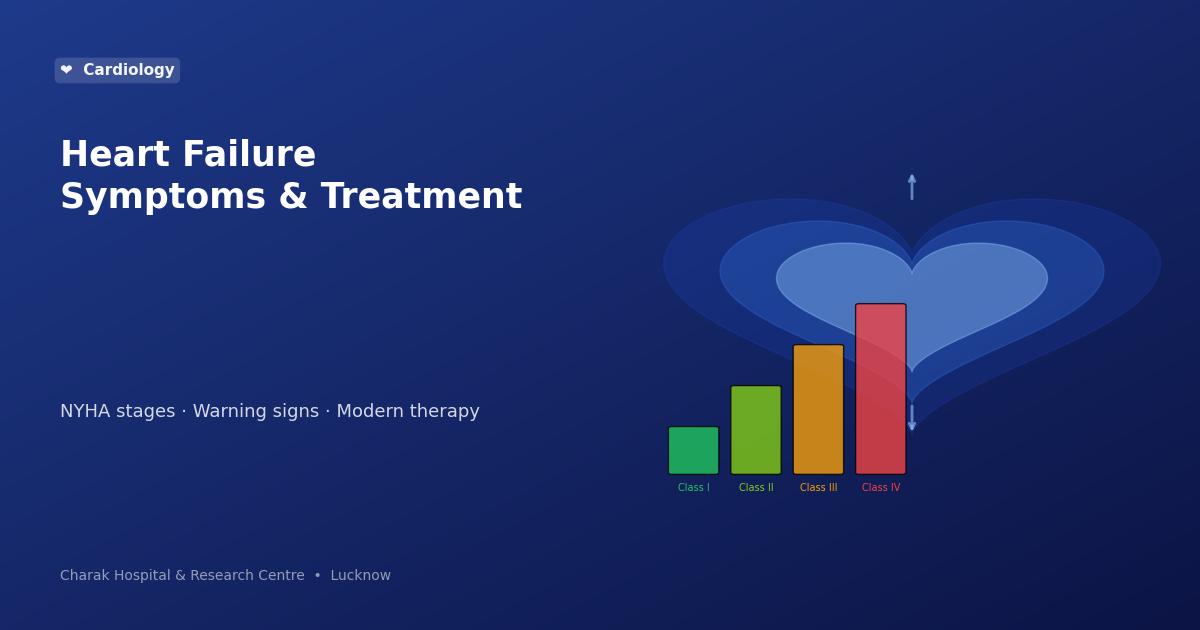
3. Stages of Heart Failure (NYHA Classification)
| Class | Description | Symptoms |
|---|---|---|
| Class I | No limitation of activity | No symptoms during ordinary activity |
| Class II | Slight limitation | Comfortable at rest; symptoms with moderate exertion |
| Class III | Marked limitation | Symptoms with minimal exertion; comfortable only at rest |
| Class IV | Symptoms at rest | Unable to perform any activity without discomfort |
With modern treatment, many patients improve from Class III to Class I — the heart can partially recover its function.
4. Causes of Heart Failure
The most common causes in India include:
- Coronary artery disease — the most common cause; blocked arteries deprive heart muscle of oxygen
- Previous heart attack — scarred heart muscle cannot contract normally
- Uncontrolled hypertension — forces the heart to work harder until it enlarges and weakens
- Valvular heart disease — damaged or leaking heart valves force the heart to pump inefficiently
- Dilated cardiomyopathy — the heart muscle weakens and the heart enlarges, sometimes without an obvious cause
- Diabetes — damages blood vessels and heart muscle over time
- Alcohol excess — alcohol is directly toxic to heart muscle (alcoholic cardiomyopathy)
- Thyroid disease — both overactive and underactive thyroid affect heart function
5. How Is Heart Failure Diagnosed?
Diagnosis is confirmed through:
- Echocardiography (Echo) — the most important test; measures ejection fraction, checks valves, detects structural abnormalities
- BNP or NT-proBNP blood test — a hormone released by a stressed heart; high levels confirm heart failure
- ECG — detects rhythm problems and previous heart attacks
- Chest X-ray — shows heart size and fluid in the lungs
- Coronary angiography — determines if blocked arteries are causing the heart failure
6. Treatment Options
Medications
Modern heart failure medications — ACE inhibitors or ARBs, beta-blockers, aldosterone antagonists, and the newer SGLT2 inhibitors — have transformed outcomes. Used together, they can improve EF by 10–20% over months, reduce hospitalizations by 30–50%, and significantly extend life. Taking all prescribed medications consistently is crucial.
Devices
- ICD (Implantable Cardioverter-Defibrillator) — prevents sudden cardiac death in patients with very low EF (≤ 35%)
- CRT (Cardiac Resynchronisation Therapy) — a special pacemaker that coordinates the two ventricles; improves symptoms and EF in suitable patients
Surgery
If blocked arteries are causing heart failure, angioplasty or bypass surgery to restore blood flow can significantly improve heart function. Valve repair or replacement is offered when valve disease is the primary cause — available at Charak Hospital's cardiac centre.
7. Living Well With Heart Failure
- Weigh yourself daily — morning, after using the toilet, before eating
- Restrict salt — aim for less than 2g sodium per day (less than hypertension patients)
- Limit fluids — your cardiologist may advise restricting total fluid intake if fluid retention is a problem
- Exercise — supervised cardiac rehabilitation improves symptoms and quality of life significantly; complete rest is harmful
- Never stop medication suddenly — this can cause acute decompensation requiring hospitalisation
- Vaccinations — get annual influenza and pneumococcal vaccines; respiratory infections worsen heart failure severely
- Regular follow-up — repeat echo every 3–6 months to monitor EF and adjust treatment
Good news: With optimal modern treatment, many patients with heart failure live active, fulfilling lives for many years. The key is early diagnosis, consistent medication, and regular specialist follow-up.
Experiencing Breathlessness or Swollen Legs?
These could be early signs of heart failure. A simple echo at Charak Hospital can assess your heart function. Early diagnosis means better outcomes.
Book Appointment 05226664444
Dr. Manish Kumar Jha
MBBS, MD, DM – Interventional Cardiology
Interventional Cardiologist, Charak Hospital
View Profile →