
The heart has four valves that act as one-way doors, ensuring blood flows in the right direction with every beat. When a valve is damaged — either too narrow (stenosis) or leaking (regurgitation) — the heart has to work much harder, eventually leading to heart failure. Valve replacement or repair restores normal blood flow and dramatically improves quality of life.
In This Article
1. Which Valves Are Commonly Replaced?
The two valves most commonly requiring surgery in India are:
- Mitral valve (MVR — Mitral Valve Replacement) — the most common valve surgery in India, often caused by rheumatic heart disease from childhood streptococcal throat infections. The mitral valve controls blood flow between the left atrium and left ventricle.
- Aortic valve (AVR — Aortic Valve Replacement) — increasingly common as India's population ages; calcification narrows the valve over decades. Also seen in younger patients with bicuspid aortic valve (born with two leaflets instead of three).
The tricuspid valve is repaired more often than replaced; the pulmonary valve rarely requires surgery in adults.
2. When Is Surgery Needed?
Valve disease can be watched for years with regular echocardiography. Surgery is recommended when:
- The valve becomes severely narrowed or leaking (determined by echo measurements)
- Symptoms develop — breathlessness, chest pain, or fainting (for aortic stenosis)
- Heart function begins to decline even without symptoms
- The heart chamber enlarges significantly — waiting too long means permanent damage
Early referral to a cardiac specialist at Charak Hospital allows regular monitoring and timely intervention before the heart weakens irreversibly.
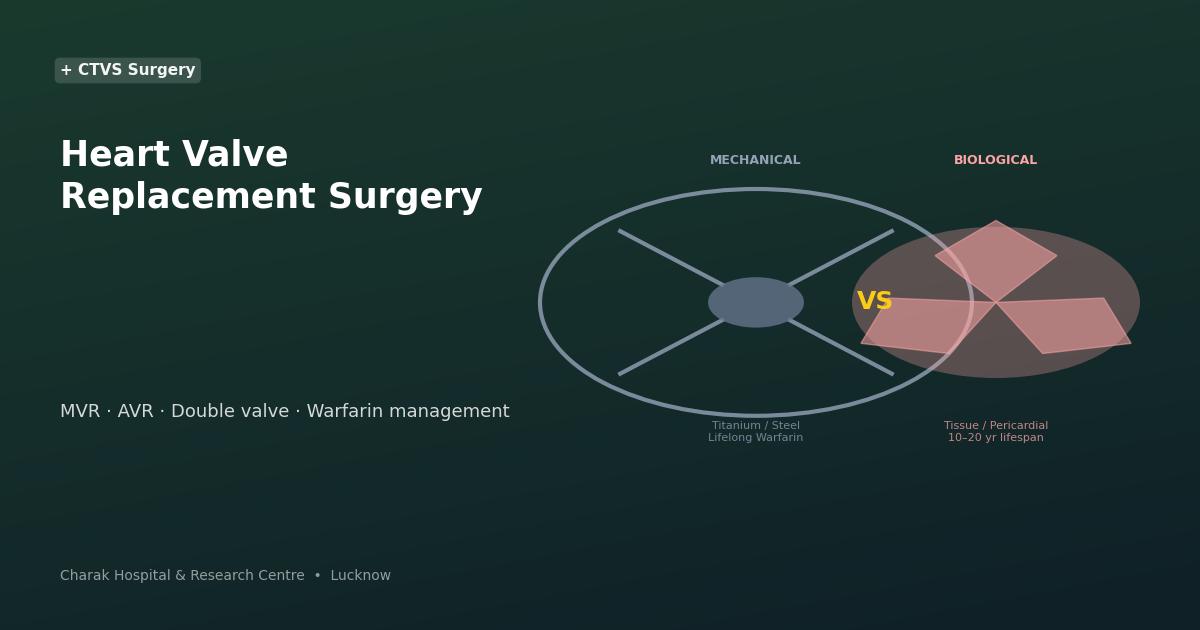
3. Mechanical vs Biological Valves
| Feature | Mechanical Valve | Biological (Tissue) Valve |
|---|---|---|
| Made from | Metal alloys, pyrolytic carbon | Pig, cow or human tissue |
| Durability | Lifelong (30+ years) | 10–20 years |
| Blood thinner (warfarin) | Required lifelong | Usually 3 months only |
| Sound | Audible clicking sound | Silent |
| Best for age | Under 60–65 years | Over 65–70 years |
| Redo surgery risk | Very low (valve lasts) | Higher (valve may degenerate) |
The choice depends on your age, ability to manage warfarin, lifestyle, and personal preference. Your CTVS surgeon will discuss both options in detail. Younger patients in India often prefer mechanical valves to avoid redo surgery; older patients prefer biological valves to avoid lifelong warfarin.
4. Double Valve Replacement (DVR)
When both the mitral and aortic valves are severely damaged — common in advanced rheumatic heart disease — both are replaced in a single operation, called Double Valve Replacement (DVR). This is more complex than a single valve operation but avoids two separate surgeries. Charak Hospital's CTVS team is experienced in DVR; you can read more on our Double Valve Replacement page.
5. The Procedure
Valve surgery is performed under general anaesthesia via a sternotomy (midline chest incision), on the heart-lung machine. The diseased valve is carefully removed and the new valve is sewn into position with precise sutures. For mitral valve repair (rather than replacement), the surgeon reshapes and tightens the existing valve using a ring — preserving the natural valve is preferred whenever possible.
Combined procedures — valve surgery with bypass grafting — are common and done in the same operation, avoiding a second heart surgery later.
Total operating time: 3–4 hours for single valve; 4–6 hours for DVR or combined procedures.
6. Recovery After Valve Surgery
- ICU: 1–2 days — monitored closely; ventilator usually removed within hours
- Ward: 4–5 days — physiotherapy, walking, diet progression
- Home by Day 6–8 — wound care instructions given
- Weeks 2–6: Avoid heavy lifting, driving, and strenuous activity. Sternum heals completely in 6–8 weeks.
- Month 2–3: Return to full normal activity, travel, desk work
- Follow-up echo at 1 month and 6 months to confirm the new valve is functioning correctly
Note: Patients with mechanical valves must establish stable warfarin dosing before discharge. INR is checked weekly initially, then monthly once stable. Keep INR between 2.0–3.0 (or 2.5–3.5 for mechanical mitral valve).
7. Living With a Mechanical Valve — Warfarin Management
Mechanical valves require lifelong warfarin (an anticoagulant) to prevent clot formation on the valve. This is manageable but requires discipline:
- Take warfarin at the same time every day
- Regular INR blood tests — initially weekly, then monthly
- Many foods affect warfarin — leafy green vegetables (spinach, methi, palak) are rich in vitamin K and can lower INR. Eat them consistently rather than avoiding them completely — the key is consistency
- Many medicines affect INR — always tell your doctor and pharmacist you are on warfarin before taking anything new, including ayurvedic or herbal preparations
- Carry a warfarin card or ID at all times
- If you experience unusual bleeding, bruising or blood in urine — contact your doctor promptly
8. Valve Repair vs Valve Replacement
Whenever possible, repairing the native valve is preferred over replacing it — particularly for the mitral valve. Repair preserves the natural valve, avoids the need for warfarin, and has better long-term outcomes for heart function. However, not all valves are repairable — heavily calcified or severely destroyed valves must be replaced. Your surgeon will assess repairability during pre-operative workup.
Charak Hospital also offers aortic valve surgery including repair and replacement. Our surgical team will recommend the approach most suitable for your anatomy and condition.
Diagnosed With Valve Disease? Get Expert Assessment.
Dr. Vijay Agarwal — CTVS specialist at Charak Hospital — reviews all valve cases and recommends repair or replacement based on your individual anatomy. Empanelled for Ayushman Bharat and all major insurance.
Book Consultation 05226664444
Dr. Vijay Agarwal
MBBS, MS, M.Ch – Cardiothoracic & Vascular Surgery
CTVS Surgeon, Charak Hospital Lucknow
View Profile →