
In This Article
How Long Do Implants Last?
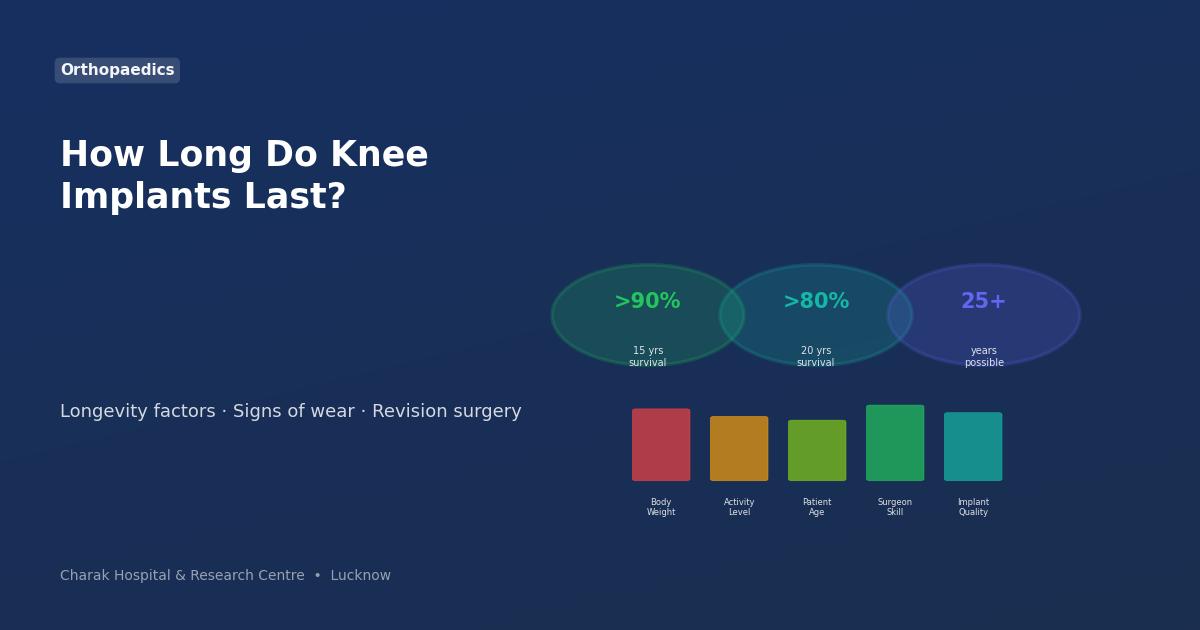
These figures come from large national joint registries — databases that track hundreds of thousands of knee replacements over decades. The data reflects implants from the 1990s and 2000s; current-generation implants are expected to perform even better due to advances in material science and surgical technique.
Important distinction: implant survival (the implant remaining in the body) differs from patient satisfaction. Some patients with intact implants may have persistent pain (in about 15–20% of cases, some degree of residual discomfort remains). Conversely, many patients are fully satisfied with their outcome many years before the implant might eventually wear.
What Is a Knee Implant Made Of?
A total knee replacement (TKR) consists of three components:
- Femoral component — caps the end of the thigh bone (femur). Made of cobalt-chromium alloy or oxidised zirconium — smooth, polished metal that glides against the plastic insert.
- Tibial component — a metal tray (titanium or cobalt-chrome) fixed to the top of the shin bone with a locking polyethylene (plastic) insert on top.
- Patella button (optional) — a plastic dome that resurfacces the back of the kneecap to reduce friction.
The polyethylene (ultra-high-molecular-weight UHMWPE) insert is the component that wears over time, just like a tyre on a car. Modern highly cross-linked polyethylene is significantly more wear-resistant than older materials and is a major reason current implants last longer.
Factors That Affect Longevity
Every extra kilogram increases joint stress. Heavier patients generate more wear on the plastic insert. Maintaining healthy weight is the single most controllable factor for implant longevity.
High-impact activities — running, heavy manual labour, sports with jumping — accelerate implant wear. Walking, swimming, and cycling are joint-friendly and recommended.
Younger patients (under 60) are more physically active and live longer with the implant — making revision surgery more likely. Older patients (70+) often outlive their implant without needing revision.
Correct implant alignment and rotation are critical. Poorly positioned implants wear unevenly and fail earlier. Computer-assisted navigation and robotic-arm guidance improve accuracy significantly.
Premium-grade implants from established manufacturers with long track records outperform discount implants in registry data. Highly cross-linked polyethylene is a significant advance over older materials.
Poorly controlled diabetes, osteoporosis, and obesity all increase the risk of early implant loosening and infection — the two most common causes of implant failure.
How to Make Your Implant Last Longer
The implant is a tool — how long it lasts depends significantly on how you use it.
- Maintain healthy body weight — the most powerful factor within your control.
- Stay active with joint-friendly exercise — walking, swimming, cycling keep the muscles supporting the joint strong without excess wear.
- Avoid high-impact activities — no running, jumping, or contact sports.
- Control diabetes and blood pressure — poor metabolic control increases infection risk, which is a leading cause of early implant failure.
- Never ignore dental work — bacteria from dental procedures can travel in the bloodstream and infect the implant. Inform your dentist about your implant; some procedures require antibiotic prophylaxis.
- Attend annual follow-up — an X-ray every 1–2 years detects early implant problems before they become serious.
- Use proper footwear — cushioned, well-fitting shoes reduce impact on the implant.
Signs Your Implant May Be Wearing
Most implant issues develop gradually. See your orthopaedic surgeon promptly if you notice:
Especially if onset is gradual after a period of pain-free years.
Persistent swelling after years of being settled may indicate polyethylene wear or loosening.
New sounds — particularly a clunking or grinding that wasn't there before — warrant investigation.
Feeling the knee is loose, gives way, or is unable to take full weight.
Always urgent — possible deep infection around the implant, which requires immediate treatment.
A leg becoming shorter or the knee appearing less straight than before may indicate implant subsidence.
What Is Revision Knee Surgery?
When a knee implant fails — from wear, loosening, infection, or instability — it can be replaced with a revision procedure. Revision surgery is more complex than primary replacement because it involves removing the original implant, preparing the bone, and fitting a larger, more complex revision implant.
Reasons for revision:
- Aseptic loosening (most common) — the implant gradually detaches from the bone over years due to microscopic wear debris causing bone resorption.
- Infection (periprosthetic joint infection) — a serious complication requiring prolonged antibiotic treatment and often two-stage surgery.
- Instability — the knee is unstable due to soft tissue failure around the implant.
- Stiffness — severe restriction of movement sometimes requires manipulation or surgical release.
- Fracture — a periprosthetic fracture (fracture around the implant) from a fall.
Importance of Follow-Up
Regular follow-up is not optional — it is essential for maximising implant life. Charak Hospital recommends:
- 6-week post-operative review
- 3-month and 12-month review in the first year
- Annual review with X-ray from Year 2 onwards
Most implant problems — loosening, early polyethylene wear — are visible on X-ray before symptoms develop. Catching these early allows intervention before the bone is significantly damaged, making revision surgery easier and outcomes better.
Joint Replacement at Charak Hospital, Lucknow
Dr. Vipul Kumar Gupta uses premium implants and precision surgical technique to maximise implant longevity for every patient. Visit the Joint Replacement Department at Charak Hospital Lucknow.
