
In This Article
What Most Patients Experience
Joint replacement is one of the most consistently successful operations in medicine. The typical patient journey:
- Day 1 after surgery — physiotherapist assists with first steps. Walking with a walker begins in hospital.
- Day 3–4 — most patients are ready for discharge home.
- Week 3–6 — walking without aids for short distances, managing stairs.
- Month 3 — most daily activities restored; driving possible (right knee: usually 6–8 weeks; left knee or hip: as advised).
- Month 6 — full recovery for most patients; mild occasional aching in cold weather is normal for up to 12 months.
Recovery Timeline — Week by Week
Physiotherapy — The Key to Success
Post-operative physiotherapy is the single most important factor in how well — and how quickly — you recover from joint replacement. Many patients who struggle with recovery are those who stopped physiotherapy too early or did not do their home exercises consistently.
Key physiotherapy milestones for knee replacement:
- Achieving 90° of knee bending by Week 3 (target: 110–120° by 3 months)
- Full extension (straight knee) — essential for normal walking gait
- Quadriceps strengthening — the muscle that controls knee stability
- Gait training — relearning natural walking pattern without limping
Activities You Can & Cannot Do
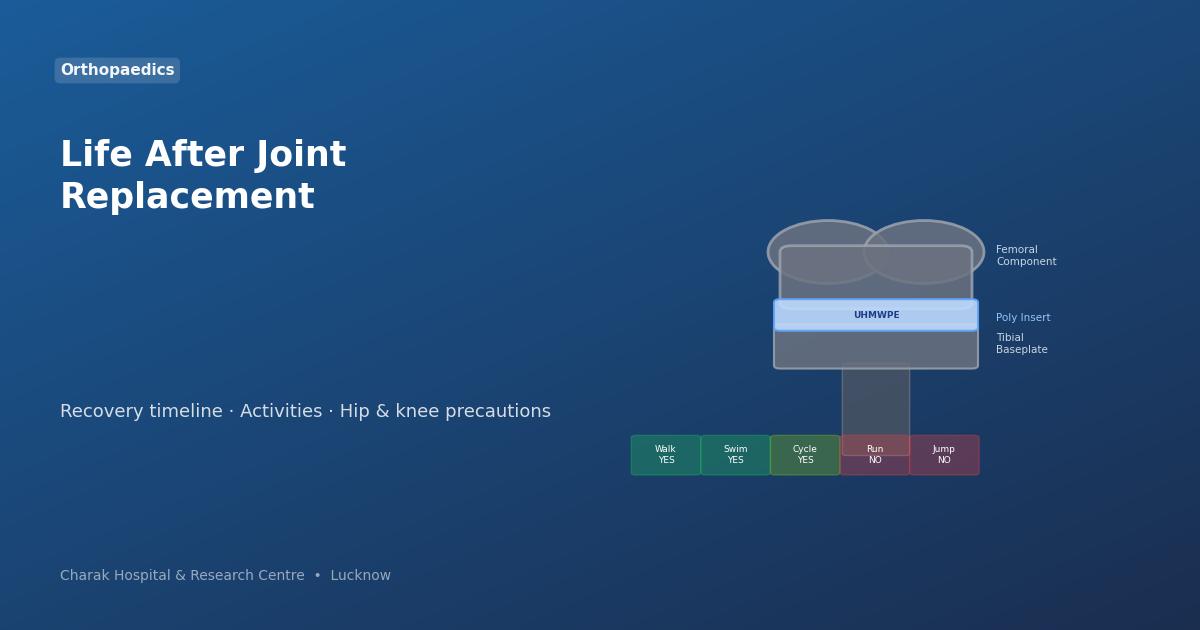
Walking (flat surface), swimming, cycling (stationary or gentle road), golf (at 3 months), social dancing, yoga (gentle, modified), light gardening, climbing stairs, driving.
Running (jogging), football, cricket (fielding), heavy lifting, high-impact aerobics, squatting (deep knee bend position), kneeling for extended periods, sports with sudden changes of direction.
Sitting cross-legged on the floor (Indian style) and using Indian-style squat toilets are generally not recommended after knee replacement. A raised toilet seat and chair-height seating are advised. Hip replacement patients should avoid extreme hip bending beyond 90°.
Hip Replacement Precautions
For the first 6–12 weeks after hip replacement, follow these precautions to prevent dislocation:
- Do not bend your hip beyond 90° (avoid picking objects from the floor by bending forward at the hip).
- Do not cross your legs or ankles when sitting or lying.
- Do not rotate your foot inward (pigeon-toed position).
- Sleep with a pillow between your legs for the first 6 weeks.
- Use a raised toilet seat and raised chair.
- When getting in a car, enter backwards — sit down first, then swing both legs in.
These precautions are primarily for traditional posterior-approach hip replacements. Anterior approach patients may have fewer restrictions — confirm with your surgeon.
Knee Replacement Precautions
- Avoid deep knee bending (beyond 110°) in the early months.
- Do not sit on low chairs, sofas, or the floor — maintain knee above hip level when seated.
- Keep the operated leg elevated when resting to reduce swelling.
- Use a handrail on stairs — operated leg goes up first when climbing; down first when descending.
- Avoid twisting movements with the foot planted on the ground.
Managing Pain & Swelling
Some pain and swelling after surgery is normal and expected — it is part of healing. Strategies that help:
- Ice packs — apply for 15–20 minutes, 3–4 times daily for the first 6 weeks. Wrap in cloth; never place ice directly on skin.
- Elevation — keep the leg raised above heart level when resting.
- Medications — take pain medications as prescribed. Do not stop blood thinners without your surgeon's advice.
- Exercise — gentle walking and ankle exercises improve circulation and reduce swelling.
Diet & Weight Management
Every kilogram of excess body weight places approximately 4 kg of extra force on the knee joint. Maintaining a healthy weight after joint replacement is one of the most important ways to extend implant life. Eat a balanced, protein-rich diet to support muscle recovery — adequate protein is essential for tissue healing in the first 3 months. Stay well hydrated, especially if on blood thinners.
Travelling After Joint Replacement
Short car trips are fine from 3–4 weeks (as passenger). Longer journeys need caution:
- On long car or train trips, stop every 60–90 minutes to walk briefly and prevent blood clots.
- Air travel: most surgeons advise waiting 6–8 weeks after surgery. Wear compression stockings. Walk the aisle regularly.
- Airport security scanners: your metal implant will likely trigger metal detectors. Carry your implant card or a letter from your surgeon.
Warning Signs to Watch For
Contact your surgeon or visit an emergency immediately if you experience:
- Sudden increase in pain, especially if previously improving
- Redness, warmth, discharge, or odour from the wound
- Fever above 38.5°C (101°F)
- Calf pain, redness, or leg swelling (symptoms of DVT)
- Shortness of breath or chest pain (pulmonary embolism — rare but serious)
- Feeling that the joint "gave way" or moved abnormally
Expert Joint Replacement at Charak Hospital
Dr. Vipul Kumar Gupta performs knee and hip replacement surgeries using modern implants and minimally invasive techniques for faster recovery. Visit the Orthopaedic & Joint Replacement Department at Charak Hospital, Lucknow.
