
In This Article
What Does the Thyroid Do?
The thyroid is a butterfly-shaped gland at the base of the neck. It produces two key hormones — T3 (triiodothyronine) and T4 (thyroxine) — that regulate the body's metabolism, energy production, heart rate, body temperature, digestion, mood, and growth.
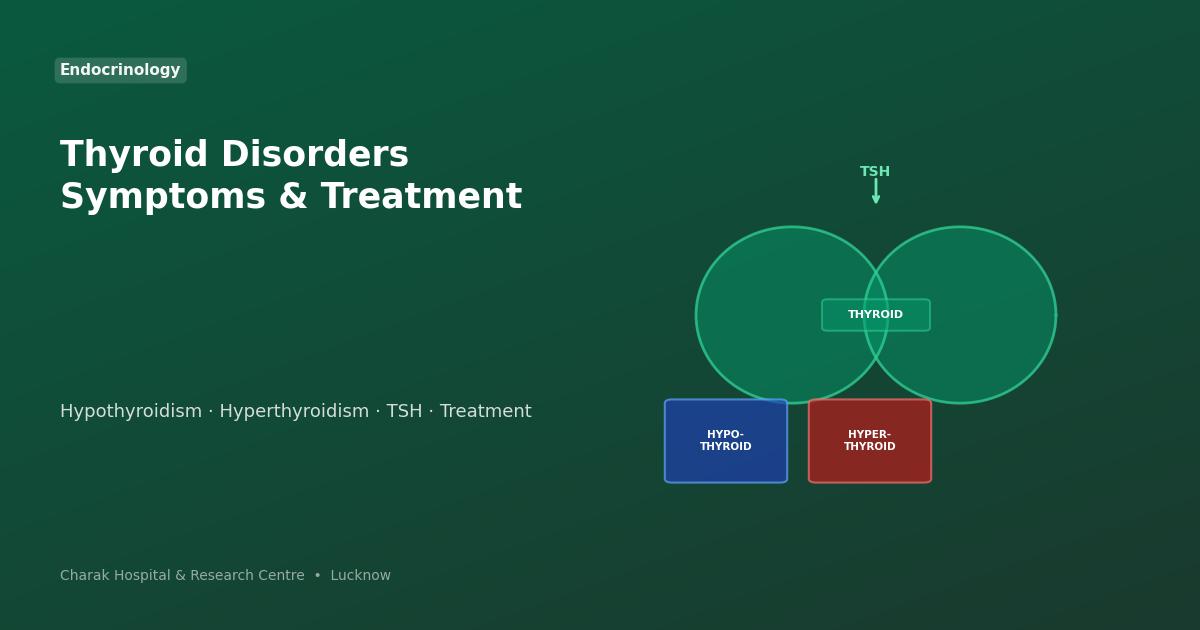
The pituitary gland in the brain controls the thyroid by releasing TSH (Thyroid Stimulating Hormone). When thyroid hormones are low, the pituitary releases more TSH to stimulate the thyroid — and vice versa. This is why a high TSH means an underactive thyroid, and a low TSH means an overactive thyroid.
Hypothyroidism — Underactive Thyroid
Hypothyroidism occurs when the thyroid produces too little hormone, slowing down the body's processes. The most common cause in India is Hashimoto's thyroiditis — an autoimmune condition where the body attacks its own thyroid.
Hypothyroidism — Common Symptoms
- Fatigue and low energy
- Weight gain despite normal diet
- Feeling cold all the time
- Constipation
- Dry skin and brittle nails
- Hair loss (diffuse thinning)
- Depression and brain fog
- Slow heart rate
- Swelling in face, hands, feet
- Irregular or heavy periods
- Difficulty conceiving
- High cholesterol
Hyperthyroidism — Overactive Thyroid
Hyperthyroidism means the thyroid is producing too much hormone, speeding everything up. The most common cause is Graves' disease — an autoimmune condition. Toxic nodules and thyroiditis can also cause it.
Hyperthyroidism — Common Symptoms
- Unintended weight loss
- Rapid or irregular heartbeat (palpitations)
- Feeling hot and sweating
- Anxiety, irritability, restlessness
- Hand tremors
- Diarrhoea
- Bulging eyes (Graves' disease)
- Difficulty sleeping
- Enlarged thyroid (goitre)
- Muscle weakness
- Menstrual irregularities
- Increased appetite
Understanding Your TSH Report
TSH is the most important thyroid blood test. Here is how to interpret it:
| TSH Level | T4 Level | Interpretation | Action |
|---|---|---|---|
| 0.4–4.0 mIU/L | Normal | Normal thyroid function | No treatment needed |
| 4.0–10 mIU/L | Normal | Subclinical Hypothyroidism | Monitor; treat if symptomatic or pregnant |
| > 10 mIU/L | Low | Overt Hypothyroidism | Start levothyroxine |
| < 0.4 mIU/L | High | Overt Hyperthyroidism | Anti-thyroid drugs / further evaluation |
| < 0.4 mIU/L | Normal | Subclinical Hyperthyroidism | Monitor; investigate cause |
Thyroid Nodules & Goitre
A goitre is an enlarged thyroid gland — visible as a swelling at the front of the neck. It can occur with hypothyroidism, hyperthyroidism, or even normal thyroid function (simple goitre from iodine deficiency).
Thyroid nodules are lumps within the thyroid. They are extremely common — found in 50–70% of adults on ultrasound — and the vast majority (95%) are benign. However, every new nodule should be evaluated because a small minority can be cancerous.
When Is a Thyroid Nodule Dangerous?
Features that require urgent evaluation by an endocrinologist:
- Rapid growth of the nodule
- Hoarseness of voice or difficulty swallowing
- Nodule hard and fixed (immobile)
- Swollen neck lymph nodes
- History of neck radiation in childhood
- Family history of thyroid cancer
Evaluation includes thyroid ultrasound and, if needed, Fine Needle Aspiration Cytology (FNAC) — a simple, minimally invasive biopsy of the nodule to check for malignant cells.
Treatment Options
For Hypothyroidism
Levothyroxine — a synthetic form of the T4 hormone — is the standard treatment. It is taken once daily, usually in the morning on an empty stomach, 30–60 minutes before food. Most patients need lifelong treatment, but the dose is adjusted based on TSH monitoring every 6 months. It is safe, effective, inexpensive, and has minimal side effects.
For Hyperthyroidism
Treatment depends on the cause and severity:
- Anti-thyroid medications (Carbimazole, Propylthiouracil) — reduce thyroid hormone production. First-line for Graves' disease. May achieve remission in some patients after 12–18 months.
- Radioactive Iodine (RAI) therapy — a capsule or liquid containing radioactive iodine-131 that selectively destroys thyroid tissue. Safe and permanent — most patients become hypothyroid afterwards and need levothyroxine lifelong.
- Thyroid surgery (thyroidectomy) — removal of part or all of the thyroid. Used for large goitres, thyroid cancer, or when medications are not tolerated.
Thyroid in Pregnancy
Thyroid disorders are particularly important in pregnancy. Untreated hypothyroidism during pregnancy is linked to miscarriage, pre-eclampsia, preterm birth, and impaired neurological development of the baby. All pregnant women with known thyroid disease — or those with high risk — should have TSH checked at the first antenatal visit and monitored throughout pregnancy. TSH targets are lower in pregnancy (<2.5 mIU/L in the first trimester).
Consult Charak Hospital's Thyroid Specialist
Thyroid disorders are highly treatable when diagnosed correctly. Dr. Anush Babu T. at Charak Hospital's Endocrinology Department provides comprehensive thyroid evaluation, FNAC, and personalised treatment plans.
